

London homeowners lead on usable equity, with three times on average more equity on average than Scots - new report
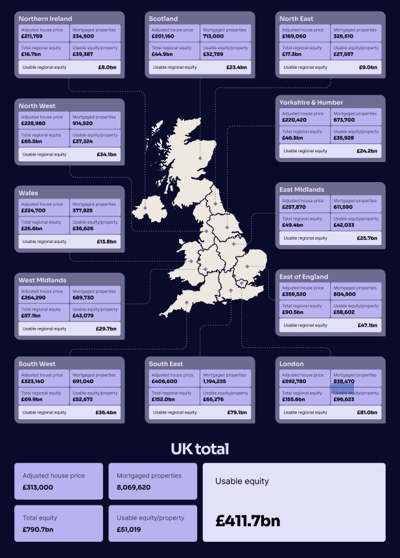
London, UK, 29 April 2026 - London’s homeowners are sitting on an estimated £81 billion in usable home equity that could generate long-term returns for families in the capital, according to new research. Usable equity is defined as that equity which can be borrowed against without exceeding sustainable LTV limits.
Despite facing a prolonged property market slowdown, mortgaged homeowners in London remain the UK’s most wealthy, with an average £96,623 in usable equity. At the other end of the scale, Scottish homeowners have just £32,789 usable equity per property.
Research from Selina Finance shows that nationally UK homeowners have accumulated around £411bn in usable equity. By using this equity to unlock credit, rather than using unsecured loans, homeowners could save nearly £19bn according to Selina.
This is already the case in the US, where homeowners are using home equity backed products to unlock cheaper borrowing. Home equity line of credit (HELOC) finance in particular has experienced significant growth in recent years, growing 7.2% in 2024 alone.
With the UK’s HELOC market projected to expand by 5.38% CAGR through to 2031, Selina Finance’s Home Equity Barometer reveals just how much usable equity exists in the UK and how much spending power it could unlock.
At a national level, mortgaged homeowners collectively hold £791 billion in total equity, with an average loan-to-value (LTV) ratio of 69%, leaving significant headroom below typical lending thresholds.
“The UK housing market has created substantial levels of wealth over time, but much of that wealth remains illiquid and, in many cases under-utilised,” said Hubert Fenwick, Co-Founder and Chief Executive Officer at Selina Finance.
“As the structure of homeownership evolves with people buying later and carrying debt for longer, it is worth considering whether traditional approaches to housing equity remain appropriate. In a higher-rate environment, households are becoming more cautious about major financial decisions, including moving home. Instead, many are choosing to stay put, reassessing how to invest in better use of their existing home and the value they already have.
“When applying a conservative borrowing threshold of 85% LTV, the research identifies £412 billion in ‘usable equity’; capital that could potentially be accessed without exceeding typical lending limits,” says Chris Hewiston, VP of Risk and Data at Selina Finance.
“However, this resource is rarely used. Instead, some households continue to rely on unsecured borrowing, often at higher interest rates which can negatively impact personal wealth over the long-term.”
Notes to editors:
- The Selina Finance Home Equity Barometer 2026 is based on analysis of data from the ONS, Bank of England and UK Finance and additional proprietary data held by Selina Finance including bespoke customer surveys.
- Usable equity is defined as borrowing capacity up to 85% loan-to-value.
- Figures exclude unmortgaged properties unless otherwise stated.
- Regional data and further information on methodology is available on request.
- This report is intended for informational purposes only. The findings are based on estimates and projections